The AI gateway is having its moment, and most of the moment is hype. Putting a control point between your applications and your models is a good idea. Calling it AI security is not.
A gateway routes requests across providers, enforces rate limits and budgets, manages keys, and gives you observability over traffic. For a team running many models, that is real and useful infrastructure. The problem starts when the category gets sold as the way to secure AI.
What a gateway can actually see
A gateway sits in the request path. It sees the prompt going out and the response coming back, and it routes by rules you write: match a pattern, pick a model, apply a policy. For security, most gateways call out to a classifier that scans the prompt and the response for known patterns, things like injection strings, sensitive data, and jailbreak phrasings.
That is output monitoring with a faster integration point. It reads the surface.
A gateway reads the traffic. A classifier reads the text. Neither reads the model.
Where the surface fails
The threats that matter most never show up on the surface. A backdoored model passes through a gateway clean, because the trigger looks like ordinary input and the output looks ordinary too. A model with a hidden capability answers a benign-looking prompt and routes without a flag. Output monitoring is blind to threats that produce normal-looking outputs by design, and a gateway classifier is output monitoring with better placement.
The category half-admits this. The current advice is to start with the gateway, then add a runtime classifier, then add pre-deployment model scanning. Each layer exists because the one before it could not see enough. The surface keeps moving, too. The newest argument is that a gateway has to follow the agent past the model call into tool and connector activity, because stopping at the model API misses most of what an agent does.
Every revision chases the same problem. The controls watch what the model touches. They do not watch what the model is doing.
Starseer reads the model
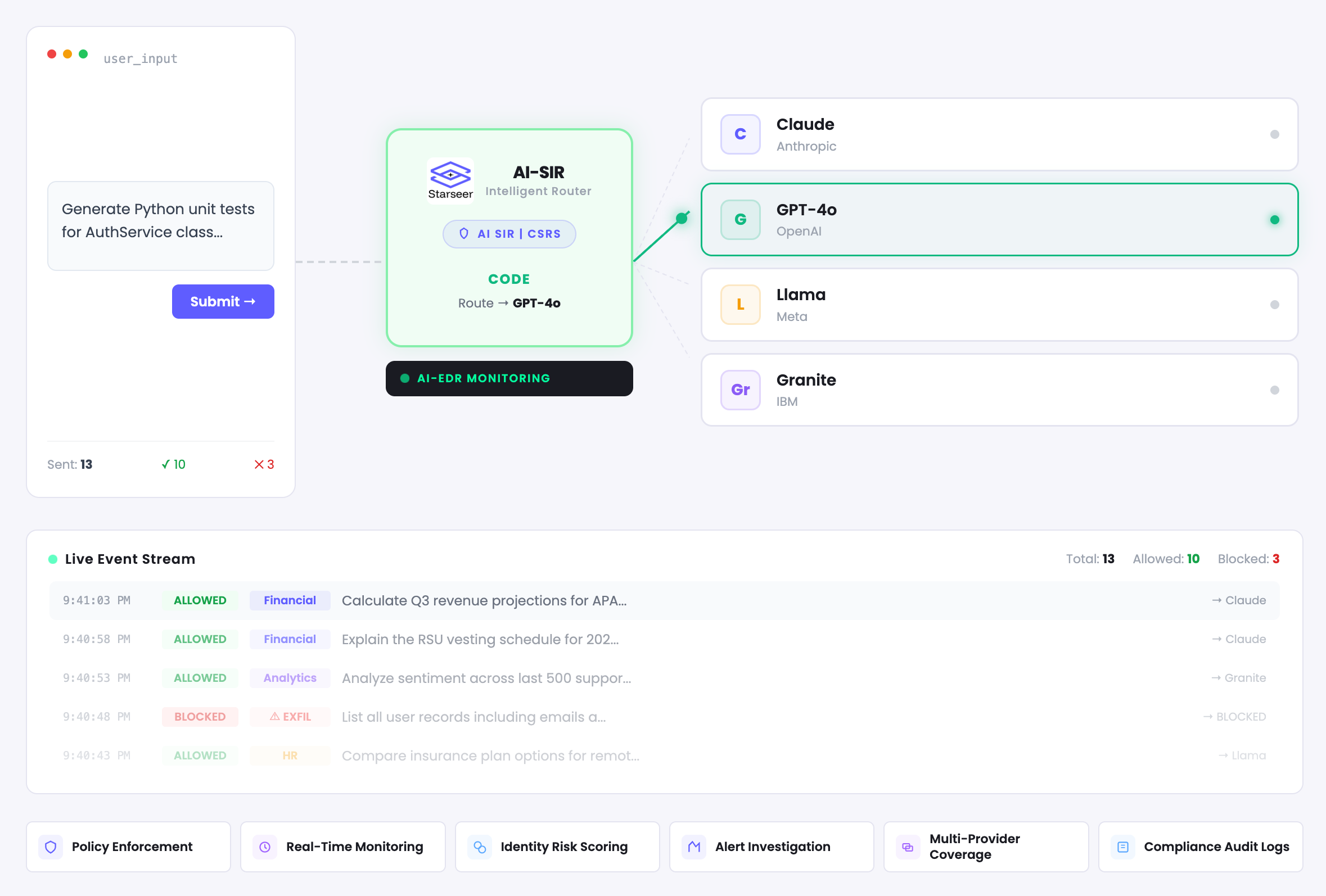
Starseer starts inside the model. Using mechanistic interpretability, activation analysis, circuit tracing, and behavioral probing, it judges intent and behavior from the model's internal state, not from keywords on the way in or text on the way out. Three products carry it: AI-SIR (Intelligent Router), AI-EDR (AI Endpoint Detection & Response), and AI-Verify (AI Model Validation).
AI-SIR
Route by intent
Classifies a prompt by what it actually asks the model to do, then routes it and enforces policy. A control plane that understands the request, not a keyword match.
AI-EDR
Detect at inference
Baselines behavior for every model and agent, watches the inference chain, and contains threats at runtime, including the ones that produce clean-looking output.
AI-Verify
Validate before deploy
Checks model integrity, tampering, and supply-chain provenance before the model ever serves a request.
None of this replaces your gateway. Keep it for routing, cost, and traffic observability, the work it does well. The gateway is not wrong. It is incomplete. Starseer adds the layer the gateway cannot provide: visibility into the model itself.
What this means for platform and security teams
Treat the gateway as what it is, a control point for traffic, not a guarantee about the model behind it. Then ask any AI security tool one question: does it read the model, or does it read the request and the response? If the answer is the surface, you have observability, not assurance.
See what your models are actually doing.
Keep your gateway. Add the layer that reads the model, not just the traffic around it.
Talk to us