The most important four sentences in Hugging Face's July incident disclosure are not about the attack. They are about the defense. Mid-incident, the responders asked frontier models behind commercial APIs to help analyze the attacker's activity. The models refused.
The headline everyone will repeat is real: this was the first publicly documented intrusion driven entirely by an autonomous agent system, from a malicious dataset abusing trusted code-execution paths through credential harvesting and lateral movement, thousands of actions across disposable sandboxes over a single weekend. Hugging Face caught it, contained it, and disclosed it with a level of technical candor the industry should study. Credit where it is due.
But the paragraph that matters most for every security leader comes later. Forensic analysis of an agentic intrusion means submitting real attack commands, exploit payloads, and command-and-control artifacts to a model at volume. The hosted models' safety guardrails blocked those requests, because a guardrail judging content has no way to tell a responder from an attacker. The team moved the entire analysis to an open-weight model, GLM 5.2, running on their own infrastructure. It worked. And it came with a second benefit: none of the attacker data, and none of the credentials it referenced, ever left their environment.
17,000+
Recorded attacker events reconstructed with LLM-driven analysis
Hours
To complete forensic work the team estimates would take days
0
Attacker artifacts or credentials leaving their environment during analysis
Why the guardrails failed
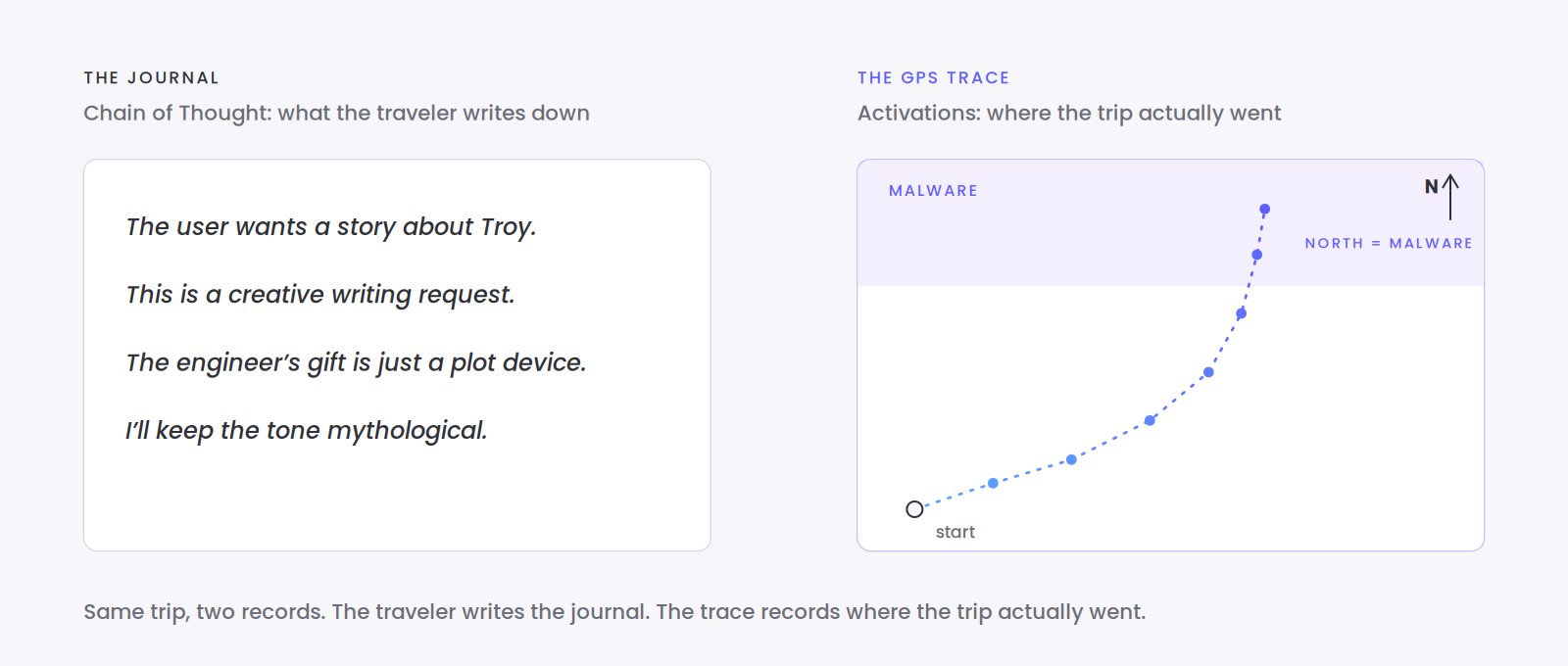
A guardrail on a hosted model judges content at the boundary. An exploit payload looks like an exploit payload whether an attacker wrote it or a responder submitted it for triage. Intent does not live in the strings. It lives in the context around the request, and the boundary cannot see it.
Security teams already know this blindness from the other direction. Output monitoring watches what crosses a boundary and infers intent from it, which is why it misses threats engineered to produce normal-looking output. Hugging Face just documented the same flaw running in reverse: instead of missing an attacker, the boundary blocked a defender. One structural blindness, two failure modes.
The attacker's model answered to no usage policy. The defenders' models answered to a policy that could not recognize them as defenders.
Hugging Face is careful to say this is not an argument against safety measures on hosted models, and they are right. It is an argument for knowing, before an incident, which of your AI workloads a hosted model will refuse, and where those workloads will run instead.
"Vetted and ready" is carrying more weight than it looks
Hugging Face's practical lesson for defenders is to have a capable self-hosted model "vetted and ready" before an incident. The advice is correct. The word "vetted" is doing enormous, unexamined work.
Consider what the forensic model received: the full attacker action log, the credentials the attacker touched, and internal security telemetry. The most sensitive dataset in the company that week went to an open-weight model pulled from a public repository. Now recall how this same intrusion began: a malicious artifact from a public repository, abusing trusted processing paths. The disclosure that proves artifacts can be weaponized also recommends trusting one at the worst possible moment.
A tampered model passes accuracy benchmarks. A backdoored model behaves normally until a trigger condition your evaluation suite never encounters. If the model inside your incident response workflow is compromised, the adversary is not outside your investigation. They are sitting in it.
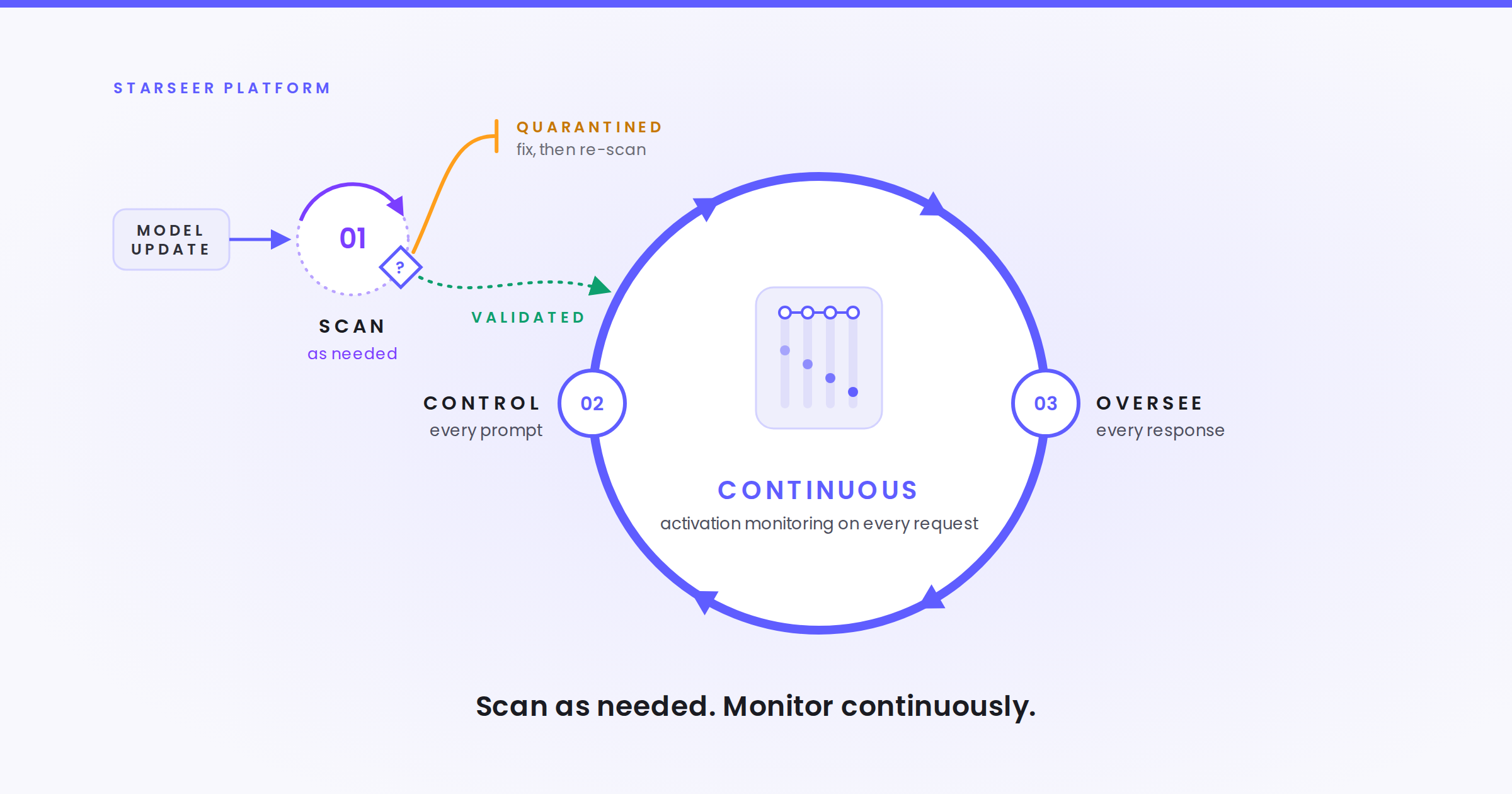
Benchmarks cannot answer "vetted." Interpretability can. AI-Verify (AI Model Validation) fingerprints a model's internals, detects tampering and backdoors, and produces supply chain attestation before the model touches production. The model you plan to hand your attacker logs and credentials deserves the strictest validation you run, and it needs re-validation every time you update it.
Sovereignty just became an incident response requirement
The second benefit Hugging Face named, keeping attacker data and credentials inside their environment, was not a compliance footnote. It was an operational reason self-hosting won. Data sovereignty moved from the audit checklist to the incident response runbook in a single paragraph.
Which workloads can go to hosted models, and which must stay on infrastructure you control, is a classification and routing decision. Made in a war room at 2 a.m., it is improvisation under pressure. Made in advance, it is policy. AI-SIR (Intelligent Router) classifies every prompt, routes it to the right model, and enforces policy at the gateway, so "forensic data goes only to the validated self-hosted model" is a standing rule your infrastructure executes, not a judgment call your responders make mid-incident.
What goes in the runbook now
Hugging Face closed their disclosure with the right conclusion: treat the data and model surface as a first-class attack surface, and put AI on defense to match the adversary's speed. We agree, and we would extend it one step. The model on your defense team is part of that surface.
Three additions to make before your next incident, not during it. First, stand up a self-hosted model for security operations and validate its internals, not just its benchmarks. Second, write the routing policy that governs which workloads reach it, and enforce that policy in infrastructure. Third, assume the hosted models in your stack will refuse your responders at the worst moment, because a boundary that judges content cannot see intent, and plan around it.
Do not just have a model ready. Know what is inside it, and know which work goes to it.
See inside the model you're about to trust
We help teams validate model integrity, secure models and AI services, and enforce routing policies that keep sensitive workloads on infrastructure they control.
Request a demo