Sovereign AI hands you the model weights. It also hands you the job of proving those weights are safe. The current wave of partnerships makes the first part easy and leaves the second part to you.
On June 29, 2026, Palantir and NVIDIA announced an initiative to run NVIDIA's Nemotron open models inside air-gapped and classified environments, with agencies keeping full control over their data and model weights. It is the third move in this direction in four months: the same partners launched a Sovereign AI Operating System Reference Architecture in March, and Dell and Palantir brought an on-premises AI operating system to commercial enterprises in May. The shift is already underway: enterprises are moving from renting hosted models to owning open-weight models inside their own perimeter. McKinsey projects the sovereign AI market could reach $600 billion by 2030.
The handoff nobody prices in
When you call a hosted model through an API, a lot of security is quietly the provider's problem. Their pipeline produced the weights. Their systems watch for misuse, and their guardrails sit between the model and the world.
Sovereignty reverses that arrangement. The day open weights land inside your enclave, their integrity becomes your responsibility, along with the fine-tuning pipeline and the runtime. You gained control, and control is also accountability.
What transfers is more than a file. You inherit the model's provenance, the pipeline that adapts it, and the runtime that serves it. Each of those was someone else's concern a moment ago, and each is now a surface you are accountable for.
This is now a board-level concern, not an infrastructure detail. In a survey of more than 2,500 organizations, 98 percent of executives said establishing a private domain to protect proprietary IP is imperative, and 35 percent of chief AI officers named sovereign AI their single biggest barrier to adoption.
Possession is not integrity
Here is the part the deployment story skips. Owning a file of weights tells you nothing about what those weights learned or whether someone changed them upstream.
An open-weight model passes through a long supply chain: pretraining, fine-tuning, quantization, and distribution. Each hop is a chance to plant a backdoor, hide a capability, or tamper with behavior in a way no benchmark will surface.
A backdoored model is the clearest example. It answers your evaluations correctly and activates only on a trigger your test suite will never send. Security leaders have started calling model weights the enterprise's crown jewels, yet most teams still wrap them in guardrails, which re-creates a perimeter without addressing that the model itself is both the asset and the risk.
Fine-tuning raises the stakes again. Every time you adapt an open model to your own data, you produce a new set of weights whose integrity you have to re-establish, not assume.
The new sovereign platforms make that a continuous condition, not an occasional event. The Palantir and NVIDIA engine collects operational telemetry and uses it to post-train the model on an ongoing basis, so customers own self-improving models specific to their mission. That is a genuine capability, and it means there is no single moment when the weights are clean. Integrity becomes a lifecycle, not a checkpoint. It also means the feedback pipeline that produces each new set of weights is itself a surface: telemetry that drives post-training is telemetry an attacker can poison.
$600B
Projected sovereign AI market by 2030 (McKinsey)
98%
Executives who call a private AI domain imperative (NTT DATA)
35%
CAIOs who call sovereign AI their biggest adoption barrier (NTT DATA)
Why watching outputs will not tell you
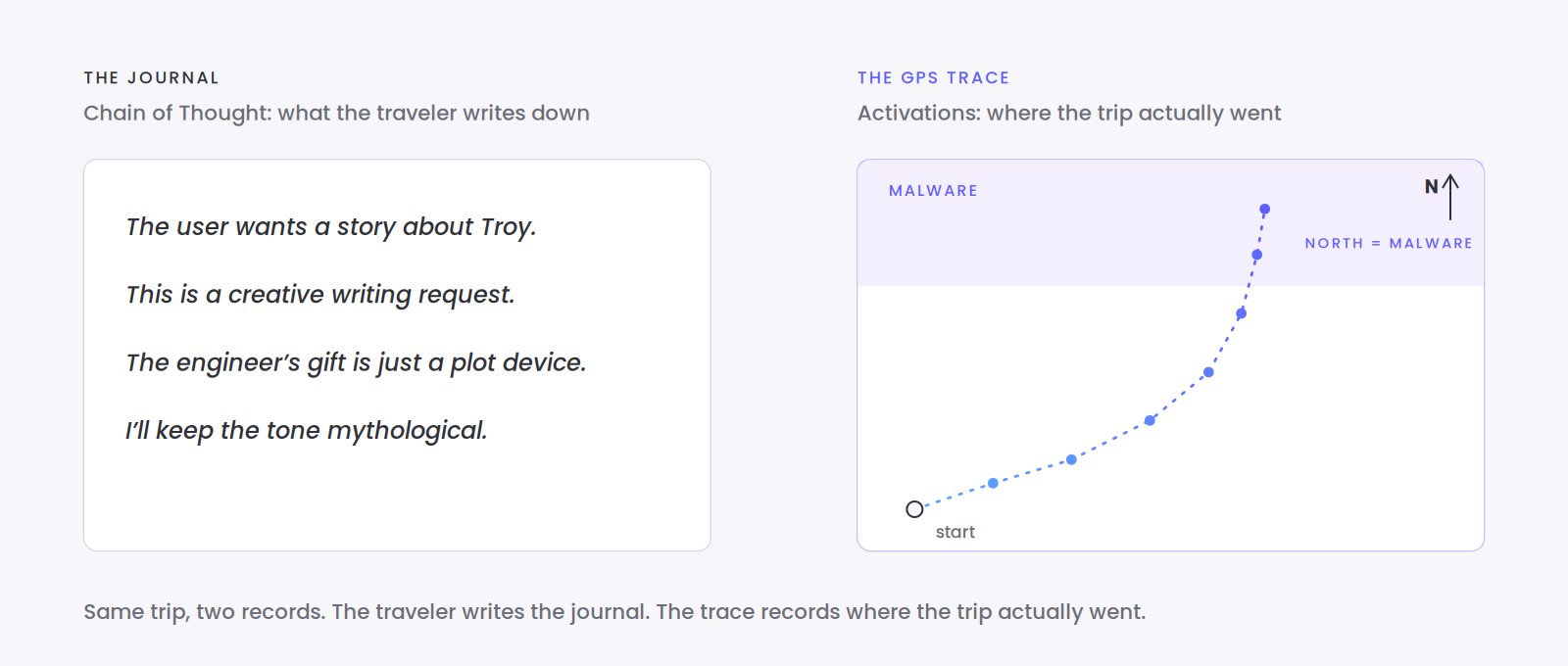
Most AI security watches outputs and infers intent. That work is necessary. It is not sufficient, because a tampered model produces normal-looking outputs by design.
Sovereignty gives you control of the model. Control is also responsibility. When the weights live inside your walls, what is inside them is yours to secure.
To answer the question sovereignty actually raises, which is what is inside this model, you have to look inside it: at its internal structure and activations, not only its responses. That is mechanistic interpretability, and it is the method that speaks to integrity rather than appearance. In practice it means examining a model's activations and tracing the circuits it uses, so you can tell a clean model from a compromised one that behaves identically on the surface.
The setting makes this sharper. In air-gapped and classified environments you cannot lean on a vendor's telemetry or phone-home guardrails. Detection has to run inside the perimeter you just built.
What this means for your team
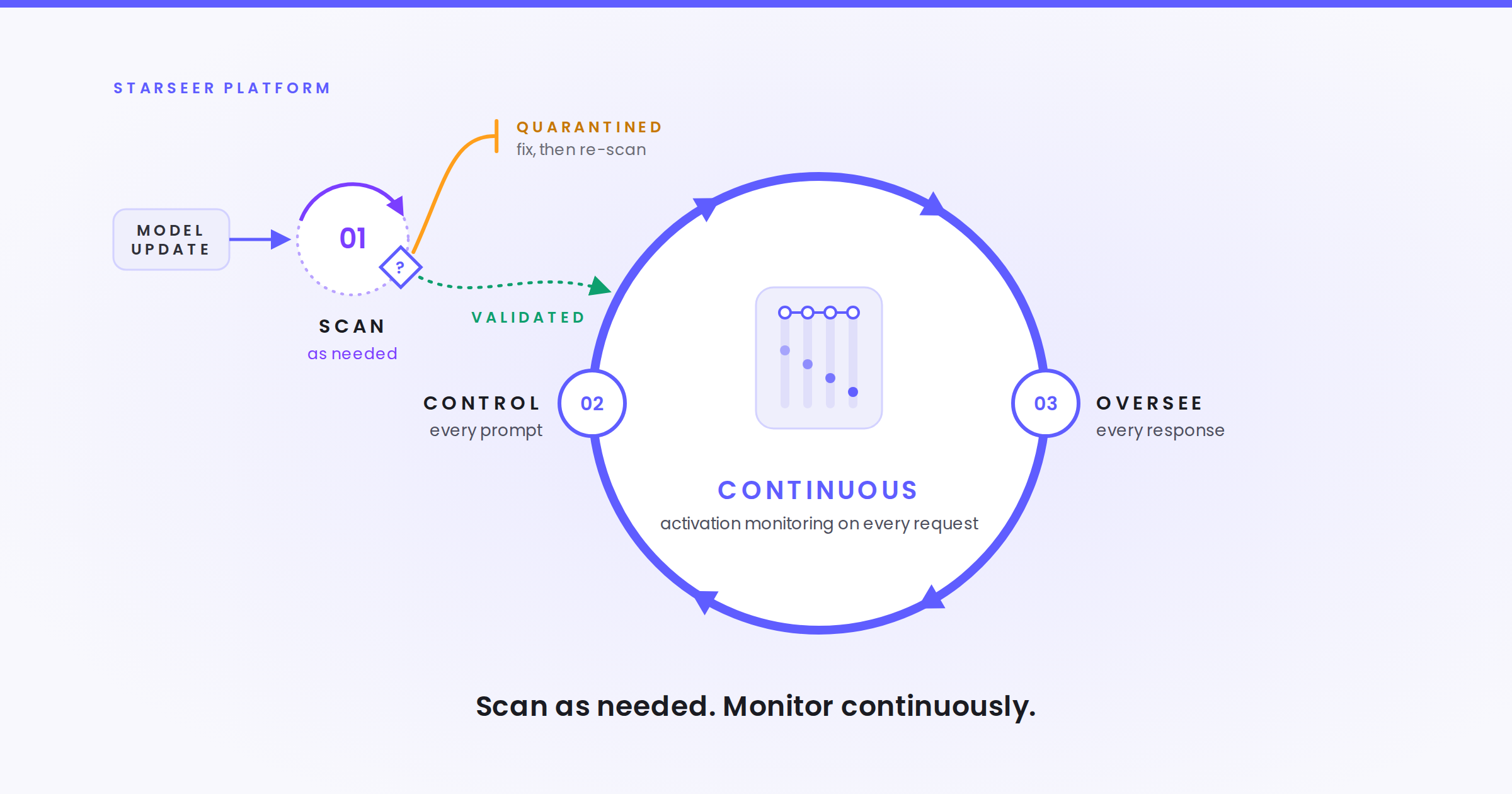
Three responsibilities move in-house the moment you go sovereign. Validate before you deploy: treat an incoming open-weight model like untrusted code entering a secure network, and confirm its integrity before it runs. Monitor after you deploy: every self-hosted model and agent is an endpoint inside your perimeter, and it needs detection and response built for how it operates. Produce your own evidence: you are now the party who has to show auditors the model is sound against the EU AI Act, NIST AI RMF, and ISO 42001.
Regulation is already pushing in this direction. EU AI Act obligations for general-purpose models take effect in 2026, and Forrester expects half of the G20 to mandate domestically tuned models, advising firms to inventory model provenance. Knowing where a model came from is a start. Knowing it is intact is the harder, and more important, question.
How Starseer helps
Starseer is the AI security platform built on interpretability, which is exactly the method a sovereign deployment demands.
AI-Verify
Validate before deployment
AI-Verify (AI Model Validation) uses interpretability fingerprinting, tamper and backdoor detection, and supply chain attestation to confirm a model's integrity before it enters your environment, and every time it changes.
AI-EDR
Monitor at runtime
AI-EDR (AI Endpoint Detection & Response) applies behavioral baselining and inference-chain visibility to every self-hosted model and agent, including in air-gapped networks.
AI-SIR
Control the gateway
AI-SIR (Intelligent Router) classifies prompts, routes them to the right model, and enforces policy at the gateway, the control plane a sovereign stack needs.
The through-line is simple. Interpretability is the method, and security is the outcome.
Sovereign AI is real, and the partnerships making it possible are only accelerating. The enterprises that win with it will be the ones who can say, in precise terms, what is inside the models they now own.
See inside the models you now own.
Validate model integrity before deployment, and monitor every model and agent at runtime, wherever it runs.
Request a demo