AI Security
Opinion

Security operations
Starseer platform alerts now stream into Splunk and any SIEM that accepts the HTTP Event Collector (HEC) format, so your SOC correlates AI threats with the rest of its telemetry.
92%
Organizations with AI-related breaches that lacked proper AI access controls
10.9
Consoles the average SOC analyst pivots across to reconstruct context
$1.33M
Added cost when a breach takes more than 200 days to identify and contain
Sources: IBM Cost of a Data Breach Report 2026; Microsoft and Omdia, State of the SOC 2026
Your SOC already triages endpoint, identity, and network alerts in one place. Alerts from the Starseer platform now land there too.
AI is already a breach target. In IBM’s 2026 Cost of a Data Breach Report, more than one in five organizations reported a breach targeting AI models or applications. Those AI-enabled breaches cost an average of $6 million, about $1 million above the global average.
Most security teams still run AI security from a separate console. That split costs them the thing a SOC does best: correlation. A blocked prompt means little on its own. The same blocked prompt, next to a file upload from the same user forty minutes later, is an incident.
Every model and agent you deploy is an endpoint. Endpoints report to the SIEM.
You configure one export sink per organization: the HEC endpoint, a token, and optional index, source, and sourcetype values. You choose a minimum severity and whether to include shadow-mode alerts. Starseer batches alerts over HTTPS, retries transient failures, and stamps every event with an alert_id so the receiver can deduplicate.
Models, agents, and gateways serving live traffic
Detects at the inference layer and inside the model
Batched JSON over HTTPS, deduplicated by alert_id
Splunk, Cribl, LogScale, or any HEC receiver
Correlation, playbooks, cases, retention
Why the SIEM can’t do this alone
The pipe is ordinary. What flows through it is not.
A SIEM correlates logs, but it never sees a model’s inference chain or its internal activations. No correlation search can reproduce a Starseer detection. Starseer produces the detection. Your SIEM puts it in context.
Who
Identity
Join them to your identity, endpoint, and cloud audit data.
What
Decision
What fired, against which model, and whether Starseer blocked or allowed it.
Where next
Pivot points
Trace and request IDs, plus a direct link back to the full investigation.
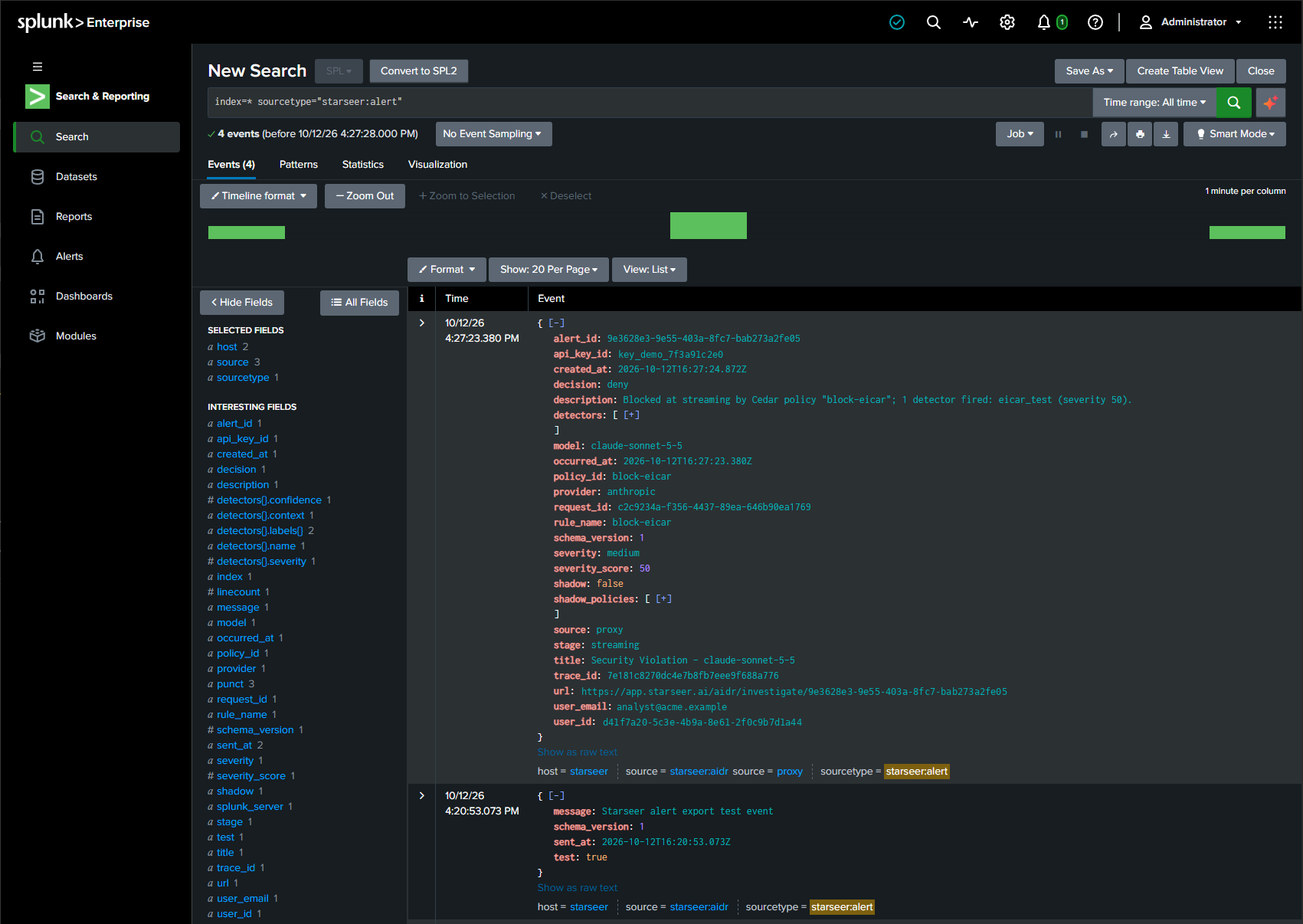
A Starseer platform alert in Splunk. Every field arrives parsed, ready for search and correlation.
Scenarios
01
A finance analyst pastes a customer export into a chat assistant. Starseer blocks the request under a data-handling policy and raises an alert with the analyst’s identity. On its own, that alert reads as a policy violation.
In the SIEM, a correlation search joins the user to endpoint telemetry. It finds the same analyst copying the same export to a personal cloud drive forty minutes later. Two weak signals become one case, and the AI alert is the first indicator on the timeline.
Blocks the prompt. Alert carries user_email.
Joins the user to endpoint and DLP events.
Same user uploads the file to a personal drive.
One insider-risk case with a full timeline.
The stakes
Negligence is the largest share of insider cost, and speed is the lever. Organizations that contain incidents within 30 days spend $14.2 million a year on insider risk. Those that take more than 90 days spend $21.9 million.
$19.5M
Average annual cost of insider risk per organization
$7.7M
Annual gap between containing in under 30 days and over 90 days
Source: Ponemon Institute and DTEX, 2026 Cost of Insider Risks Global Report
02
An accounts-payable agent processes inbound vendor invoices. One PDF carries an indirect prompt injection that instructs the agent to call its payments tool. Starseer blocks the tool call and raises an alert with the trace and request IDs.
The analyst pivots from the agent alert to the email gateway logs in the same SIEM. They find the sender, then every other mailbox that received the same attachment. The SOC scopes a phishing campaign aimed at AI agents, not people, from the first alert.
Poisoned invoice PDF arrives.
Ingests it and attempts a payments tool call.
Blocks the call. Alert carries trace_id.
Pivots to email logs and scopes the campaign.
The stakes
Prompt injection breaches cost more than the average breach. The goal of this attack is a fraudulent payment, the same outcome business email compromise targets.
$5.89M
Average cost of a breach involving prompt injection
$3.05B
Business email compromise losses reported to the FBI in 2025
Source: IBM Cost of a Data Breach Report 2026; FBI IC3 2025 Internet Crime Report
03
A developer commits an API key to a public repository. Within hours, someone uses it for LLMjacking: they run jailbreak attempts through your AI gateway on your account. Starseer blocks the attempts, and every alert carries the same API key ID.
A SIEM threshold search fires on the burst of blocks from one key. Your existing playbook checks cloud audit logs, confirms requests from an unfamiliar network, revokes the key, and notifies its owner.
No new AI-specific runbooks or response workflows required. Starseer HEC brings AI security detections into the security operations processes your team already uses.
Key lands in a public repo. Jailbreak traffic starts.
Blocks each attempt. Alerts share api_key_id.
Threshold search fires on one key.
Confirms the source, revokes the key, notifies the owner.
The stakes
Stolen model access bills by the hour. Every hour between the first block and revocation is spend you cannot recover.
$100K+
Potential daily cost to a victim of LLMjacking on frontier models
61,000
Requests sent in three hours during one observed campaign
Source: Sysdig Threat Research Team, LLMjacking research (2024)
Outcomes
01
Close the AI blind spot
Most SOC detection content targets familiar threats: Microsoft and Omdia found 52% of positive alerts map to known vulnerabilities. Prompt injection, agent hijacking, and LLMjacking never touch an endpoint or network sensor. Starseer alerts bring models and agents inside your detection coverage.
02
Enforce at the model, prove it in the SIEM
Starseer enforces policy in the inference path, grounded in what happens inside the model, not only what it outputs. Every allow and deny lands in the SIEM with the policy, model, and identity attached: an investigation lead for analysts and audit evidence that AI policy is enforced.
03
One queue, the playbooks you already run
Analysts triage AI alerts next to everything else, without adding an eleventh console. Saved searches, SOAR playbooks, and ticketing apply on day one, so containment runs on response paths your team has already tested.
04
Tune before you enforce
With 46% of SOC alerts already false positives, a new policy should prove itself first. Export shadow-mode alerts to see what it would block against real traffic, tune it in the SIEM, then switch it to enforcement.
See Starseer alerts in your SIEM.
We’ll connect a test sink to your Splunk or HEC endpoint and walk through the first correlation search with your team.
Request a demoSources
IBM, Cost of a Data Breach Report 2026
Microsoft and Omdia, State of the SOC: Unify Now or Pay Later (2026)
Ponemon Institute and DTEX, 2026 Cost of Insider Risks Global Report
FBI Internet Crime Complaint Center, 2025 Internet Crime Report
Sysdig Threat Research Team, The Growing Dangers of LLMjacking (2024)