
— AI Endpoint Detection & Response
Stop AI Threats at the Endpoint.
Every model and agent in your environment is an endpoint. AI-EDR gives your security team full telemetry, detection coverage, and automated response — built for the way AI systems actually operate.
Everything a security team needs for AI Endpoints
Behavioral Baseline Profiling
Builds AI-native baselines on output distributions, latency patterns, data access, and tool invocation frequency. Alerts on statistically meaningful deviations, not just rule-based thresholds.
Adversarial Activity Detection
Identifies prompt injection, agent hijacking, LLMjacking, unauthorized tool use, and covert agentic workflows as they occur, before business impact.
Automated Containment
Initiates throttling, isolation, or suspension within milliseconds of a confirmed threat. Preserves forensic state for investigation without disrupting adjacent systems.
Automated Response & Remediation
When unsafe behavior is detected, Starseer triggers automated containment, rollback, and retraining workflows, preserving system integrity while generating audit-ready evidence for governance and compliance.
Incident Response Root Cause Analysis
Deep, model-aware root cause analysis, tracing AI incidents back to the exact model, data, or decision pathway that caused them.
Forensic Logging & Compliance Evidence
Generates continuous audit trails, behavioral reports, and risk assessments aligned to MITRE ATLAS, NIST AI RMF, ISO 42001, and sector regulations. Every detected incident produces machine-readable evidence for investigators, regulators, and auditors.
Why AI-EDR
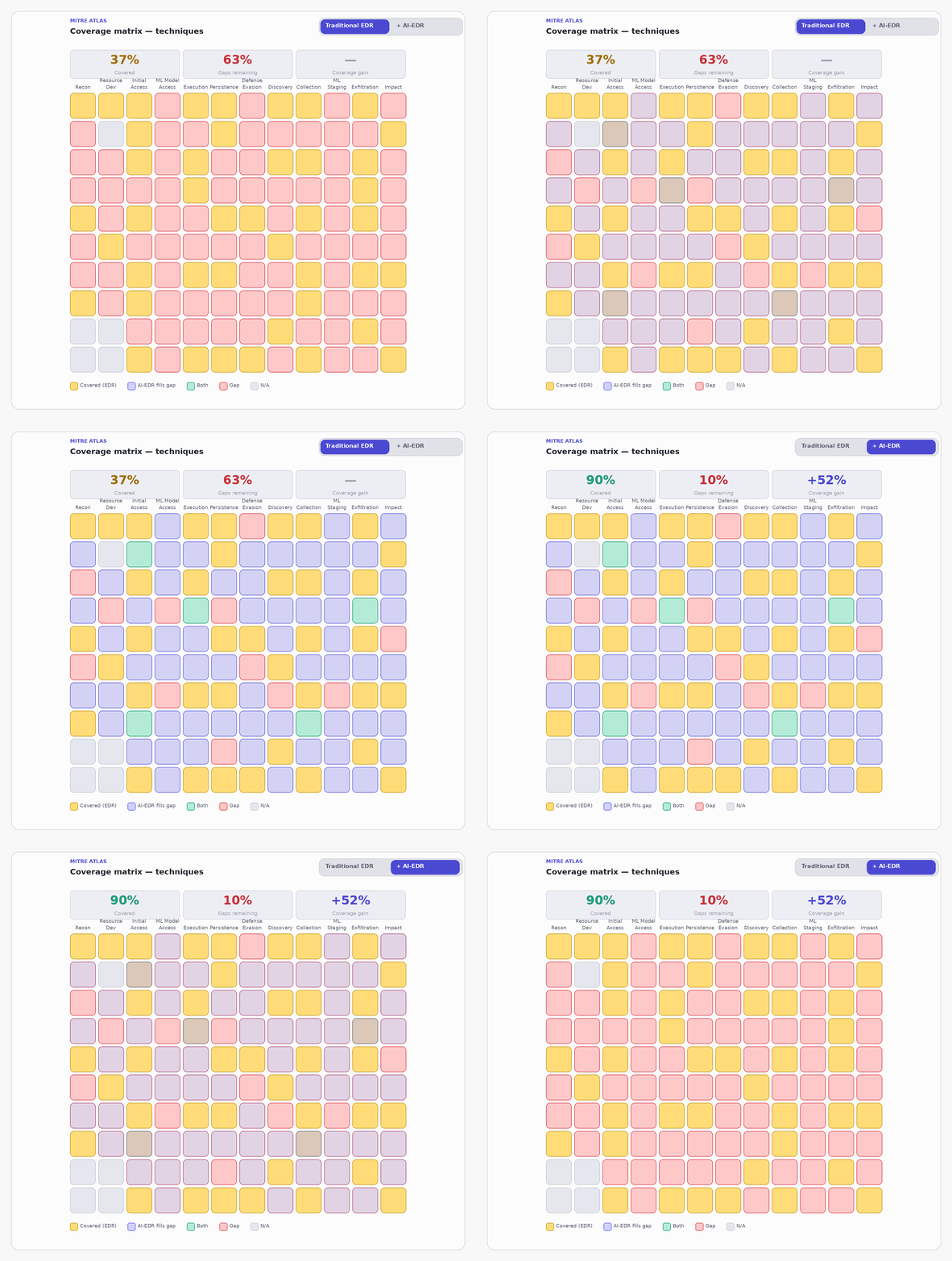
Traditional EDR can't see this.
- Blind to prompt flows: Sees file I/O and network calls, not what a model was asked or why it took an action.
- No inference chain visibility: Cannot inspect reasoning paths, tool invocations, or agentic decision sequences.
- Semantic drift is invisible: Behavioral baselines are built on binary processes, not probabilistic AI output patterns.
- Can't detect prompt injection: Adversarial prompt manipulation doesn't trigger OS-level signals. It's completely invisible.
The benefits teams are seeing.
Explore Starseer's capabilities
Unlock powerful AI runtime assurance capabilities with our all-in-one platform.
.png?width=1080&height=1350&name=Untitled%20design%20(1).png "Untitled design (1)")
Decision Path Monitoring
Tracks agent reasoning chains, prompt flows, and tool invocations to identify abnormal or manipulated execution.
Behavioral Baseline Modeling
Establishes normal operating patterns for models and agents to detect drift, misuse, and emerging risks.
Adversarial Activity Detection
Identifies agent hijacking, prompt injection, LLMjacking, and covert automation workflows in real time.
Unauthorized Access & Data Flow Monitoring
Detects unsafe data access, exfiltration attempts, and policy violations across AI pipelines.
Risk Scoring & Prioritization
Continuously assesses operational and security risk to focus response on the highest-impact threats.
Automated Containment Actions
Initiates throttling, isolation, suspension, or rollback when unsafe behavior is detected.
Incident Response & Recovery
Orchestrates remediation, retraining, and validation processes to restore safe operations quickly.
Forensic Logging & Audit Evidence
Preserves detailed execution records to support investigations, compliance, and regulatory reporting.
Frequently asked questions
How is AI-EDR different from traditional EDR or SIEM?
Can we detect when attackers or insiders are abusing our AI systems?
Yes. Starseer deploys runtime detectors that identify agent hijacking, prompt injection, LLMjacking, unauthorized integrations, and covert workflows, enabling early intervention before business or security impact occurs.
What does "enrolling an AI endpoint" look like in practice?
Can we threat-hunt across historical AI activity?
How do we optimize performance and cost without increasing risk?
Starseer monitors latency, throughput, and resource consumption alongside behavioral risk, enabling teams to safely tune models, manage token usage, and optimize infrastructure without compromising security or reliability.
Your AI endpoints are live. Are they protected?
Start your free trial and see what's already happening inside your AI environment — before someone else shows you.